

Dig Deeper: Isua Rocks
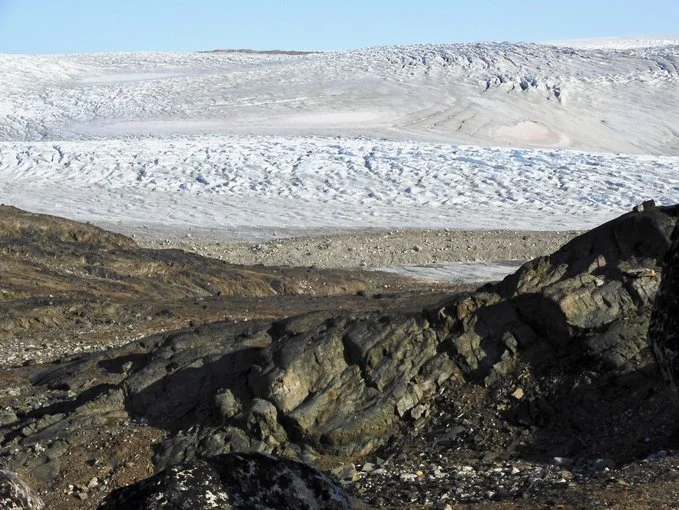
Rocks exposed on the edge of the Greenland ice sheet at Isua.
Image Credit: Mark Kaufman, NASA
The rocks at Isua, on the southwestern coast of Greenland (near the capital of Nuuk) formed between 3.7 and 3.9 billion years ago. They were until recently the oldest known rocks in the world. That recognition now belongs to the Acasta Gneiss which is exposed around Great Slave Lake in Canada’s Northwest Territories and dates to just over 4 billion years ago.
The rocks at Isua, sometimes known as the Isua Complex, Isua Greenstone Belt, or Isua Supracrustal Belt, consist of a narrow outcrop about 30 km (ca 19 miles) long. They include a number of kinds of rocks, all of which are metamorphosed to a greater or lesser degree, but many features of the original rocks can still be reconstructed.
The complex includes the oldest known banded iron formation and oldest known pillow basalts, which are basalt extruded in water. And they include metamorphosed sediments. These rocks collectively prove that there was already enough standing water on Earth for sediments to be eroded from still older rocks.
The world’s oldest fossils?
The Isua rocks are perhaps best known for containing some of the oldest known traces of life. These “chemical fossils” are contained in minute specks of the mineral graphite (metamorphosed carbon) within crystals of various other minerals. Analysis of the isotopes of carbon in this graphite suggest that at least some of it passed through living cells. (Most carbon is the isotope 14C, but carbon compounds formed by living organisms contain relatively more of the lighter and less common isotope 13C. The Isua graphite has a “negative” carbon isotope value, meaning more of the lighter isotope, which is characteristic of life.)