Corinne Myers
Corinne Myers
Corinne Myers
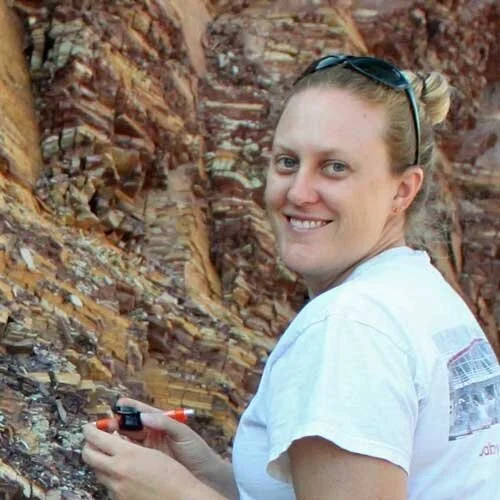
Paleobiologist
Corinne (“Cori”) Myers is a paleobiologist. She studies paleoecology, macroevolution, and biogeography of animals that lived in the Cretaceous Western Interior Seaway, a sea that covered the center of the North American continent.
Cori attended Cornell University, receiving her bachelor’s degree with a major in Science of Earth Systems. As an undergraduate, she did research on reconstructing the paleoenvironment of North Carolina. After receiving her degree, she took a gap year to work at the Paleontological Research Institution in Ithaca, New York, where one of her tasks was designing museum exhibits. She later earned a master’s degree in igneous geochemistry from Brown University. During a trip to the Galapagos Islands for her master’s research, she realized that she wanted to switch her research focus to incorporate more biology.
For her doctoral research, she went to the University of Kansas. She did research in paleobiology, working on marine animals from the Western Interior Seaway, an ancient sea that covered the middle of the North American continent during the Late Cretaceous (about 100.5 to 66 million years ago). She earned her PhD in 2013. She then had a two-year postdoctoral fellowship (a temporary research position) at Harvard University funded by the NASA Astrobiology Institute Postdoctoral Fellowship Program. In 2015, Cori began a tenure-track faculty position at the University of New Mexico, where she is currently an Assistant Professor in the Department of Earth and Planetary Sciences.
Cori is a paleobiologist with broad research interests, including paleoecology, macroevolution, and taphonomy (taphonomy is the study of how organisms are preserved after they die). Her research is focused on the Western Interior Seaway, where she studies mollusks and vertebrates. She is interested in how abiotic (non-biological) environmental factors affect the origination, extinction, and geographic distribution of fossil species. She also studies how mollusks are preserved in the fossil record.
In the field
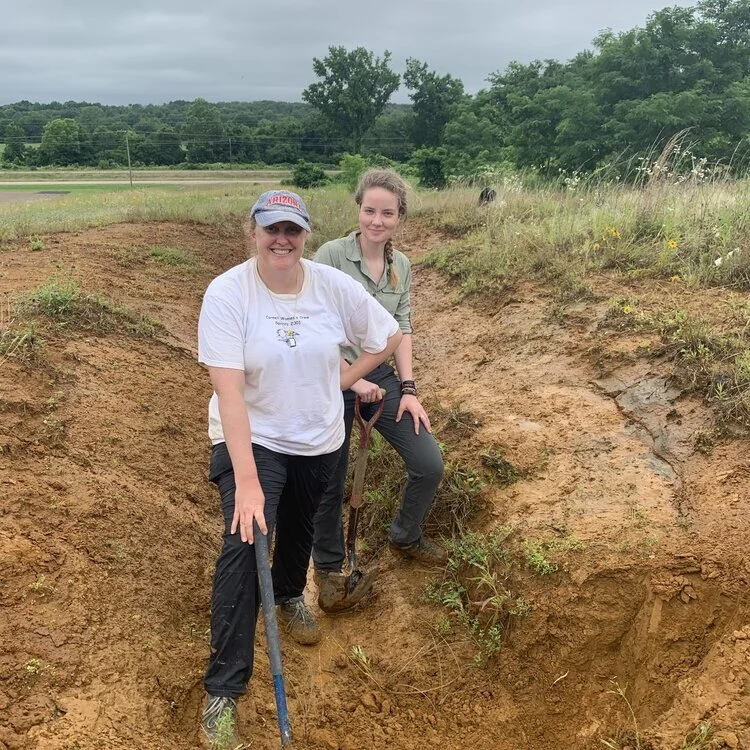
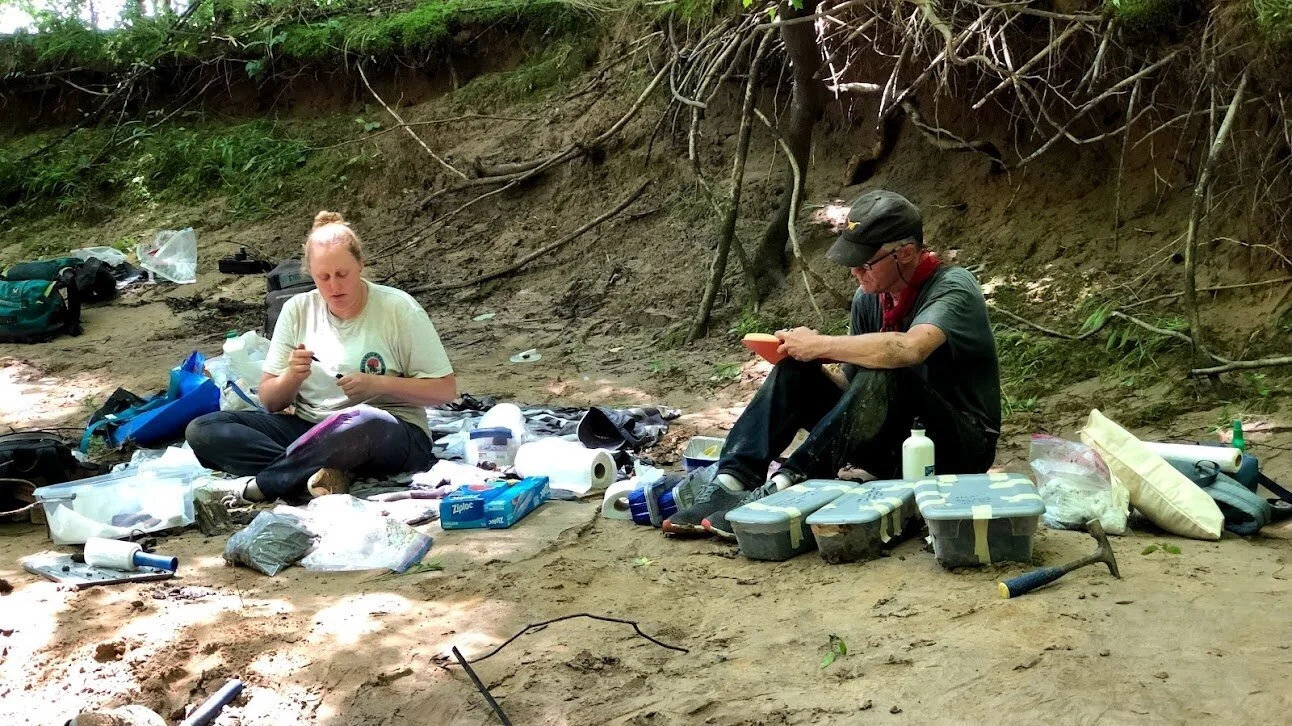
The photos below show Cori doing field work in Mississippi in 2021. Read the full story on PRI’s blog. (The photos below are part of a gallery; click on each photo to see the full-size image and complete caption.)
Daring to Dig Interview
In this interview, Cori discusses her education and research interests, reflecting on her experiences as a woman and a mother in academia. She also discusses why women tend to disproportionately leave the academic science career path. This interview was recorded in 2017.
Content note: This interview includes a brief mention of sexual harassment.
Selected technical works by Cori Myers
Ludt, W.B., and C.E. Myers. 2021. Distinguishing between dispersal and vicariance: A novel approach using anti-tropical taxa across the fish Tree of Life. Journal of Biogeography 48: 577–589. Link
Myers, C.E., and E.E. Saupe. 2013. A macroevolutionary expansion of the Modern Synthesis and the importance of extrinsic abiotic factors. Palaeontology Special Issue: Macroevolution and the Modern Synthesis 56: 1179–1198. Link
Myers, C.E., A.L. Stigall, and B.S. Lieberman. 2015. PaleoENM: applying ecological niche modeling to the fossil record. Paleobiology 41: 226–244. Link
Myers, C.E., K.D. Bergmann, C.-Y. Sun, N. Boekelheide, A.H. Knoll, and P.U.P.A. Gilbert. 2018. Exceptional preservation of organic matrix and shell microstructure in a Late Cretaceous Pinna fossil revealed by photoemission electron spectromicroscopy. Geology 46:711–714. Link
Saupe, E.E., C.E. Myers, A.T. Peterson, J. Sóberon, J. Singarayer, P. Valdes, and H. Qiao. 2019. Spatio-temporal climate contributes to latitudinal diversity gradients. Nature Ecology and Evolution 3: 1419–1429. Link
Further reading
Allmon, W.D. 2021. In search of the last Cretaceous turritellid gastropod, and the aftermath. Paleontological Research Institution blog. Link
Black, R. 2013. Fossils of future past. National Geographic, 24 January 2013. Link
Dyer, J. 2017. A forever home for fossils. Albuquerque Journal, 28 December 2017. Link