
Judith Nagel-Myers
Judith Nagel-Myers
Judith Nagel-Myers
Paleobiologist
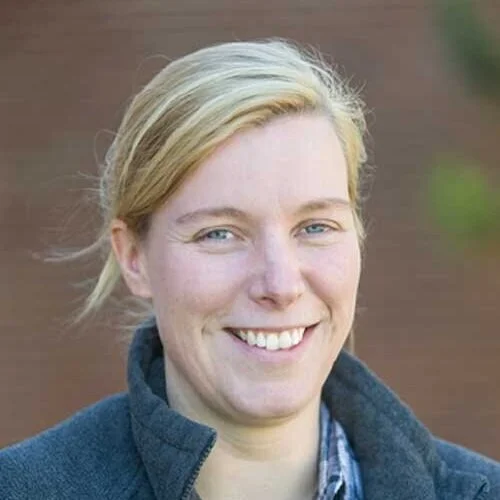
Judith Nagel-Myers is a paleobiologist. She studies form and function in marine (saltwater) invertebrates, especially bivalves (mollusks with two-pieced, hinged shells, like clams).
Judith received her master’s degree and Ph.D. from Westfälische Wilhelms-Universität Münster in Münster, Germany. She subsequently worked at the Paleontological Research Institution in Ithaca, New York, as a postdoc (a temporary position as a research scholar) and later as a collections manager. In 2013, she moved to Canton, New York, to teach in the Geology Department of St. Lawrence University, where she is currently an Associate Professor. She teaches courses in geology and paleontology and views her role as a student advisor and mentor to be an integral part of her job.
Judith studies the form and function of marine (saltwater) invertebrates, with a particular focus on bivalves. Bivalves are mollusks with shells made up of two separate parts (valves) that can open and close at a hinge; examples of bivalves are clams, oysters, and scallops. Judith explores how predators impact shell shape and investigates how the shapes of bivalve shells are affected by the environments in which they live. She also studies the ways abiotic (non-biological) factors like the substrate (the surface on which or in which an organism lives, like sand or rock) or water currents control the development of shell shapes. She works with Paleozoic taxa (541 to 252 million years old) as well as modern freshwater bivalves from the lakes and rivers of northern New York.
Daring to Dig Interview
In this video, Judith discusses the lack of female role models and collaborators that she has experienced during her education and career. She also talks about the gendered expectations of her as a faculty member, as well as the challenges of becoming a mother while advancing on a career path in science, especially in a field-oriented science like paleontology. This interview was recorded in 2017.
Selected works by Judith Nagel-Myers
Nagel-Myers, J., M. Amler, and R. Becker. 2008. Vetupraeca n. gen. and Mucopraeca n. gen. (Cryptodonta, Bivalvia): A reappraisal of Late Devonian bivalves from the Hercynian Facies. Journal of Paleontology 82: 1150–1160. Link
Nagel-Myers, J., G.P. Dietl, and C.E. Brett. 2009. First report of sublethal breakage-induced predation on Devonian bivalves. PALAIOS 24: 460–465. Link
Nagel-Myers, J., G.P. Dietl, J.C. Handley, and C.E. Brett. 2013. Abundance is not enough: The need for multiple lines of evidence in testing for ecological stability in the fossil record. PLoS ONE 8(5): e63071. Link
Nagel-Myers, J., C.A. McRoberts, and C.W. LaPointe. 2018. Ecophenotypic variability during times of evolutionary stasis in Middle Devonian Actinopteria (Bivalvia, Pterioidea) from New York. Journal of Paleontology 92: 388–397. Link
Nagel-Myers, J., I. Mastorakos, P. Yuya, and G. Reeder. 2019. Modelling crushing crab predation on bivalve prey using finite element analysis. Historical Biology. Link
Further reading
Cornell University. 2013. Clam fossils divulge secrets of ecologic stability. ScienceDaily, 15 May 2013. Link