

Chordates
Chordates
Chordates (Phylum Chordata) is the group that includes vertebrates (animals with backbones, including humans), but also includes some invertebrates. These non-vertebrate chordates include a wide diversity of forms, some of which are extremely abundant in the oceans. Chordates all have (at some point in their life) a few features in common, including a notochord (a stiff cartilaginous rod on the upper or dorsal side of the body), a central nerve (the spinal cord), segmented V-shaped muscles in the body wall, and a bag-shaped area in the head that holds gills (the pharynx).
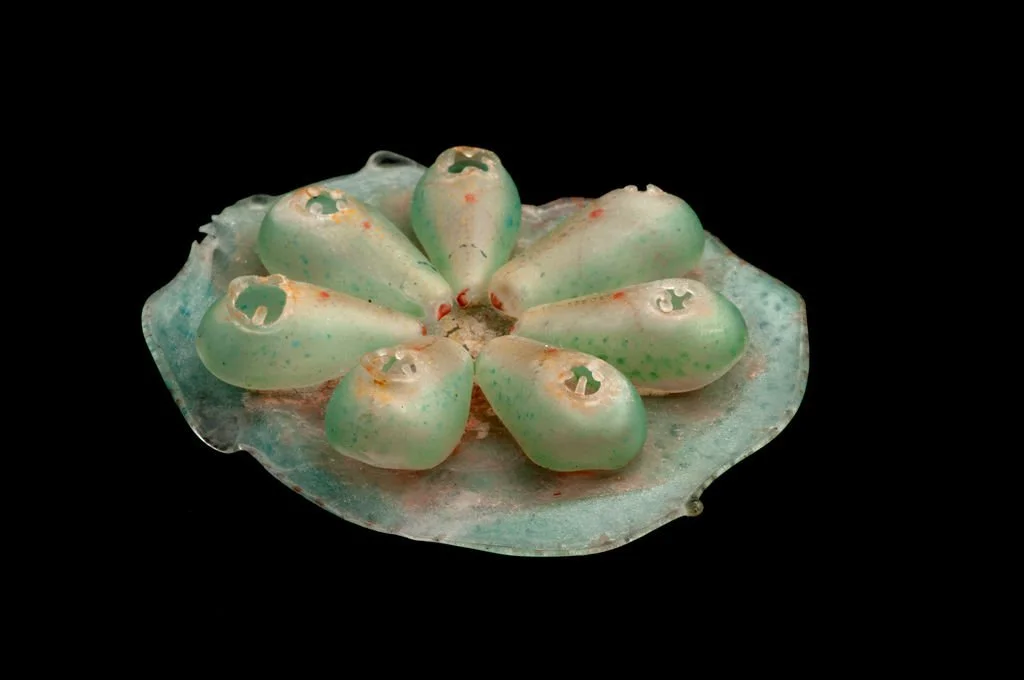
Botryllus schlosseri, from Cornell Collection of Blaschka Invertebrate Models. Photo: Claire Smith, used with permission from Cornell University.
Tunicates are a group of non-vertebrate chordates that as adults definitely do not look follow the familiar vertebrate body plan. But as larvae, tunicates resemble tadpoles, with a head, tail, and gills. The larvae metamorphose into adults that attach to the seafloor and become filter-feeders, using their gills as sieves to remove food from the water. Adult tunicates have inhalant and exhalent openings for directing water in and out of their bodies, and can be mistaken for sponges. Some are colonial, with numerous clonal individuals living together in a mass that can cover large areas of seafloor. Tunicates are completely soft-bodied, with no mineralized skeleton.
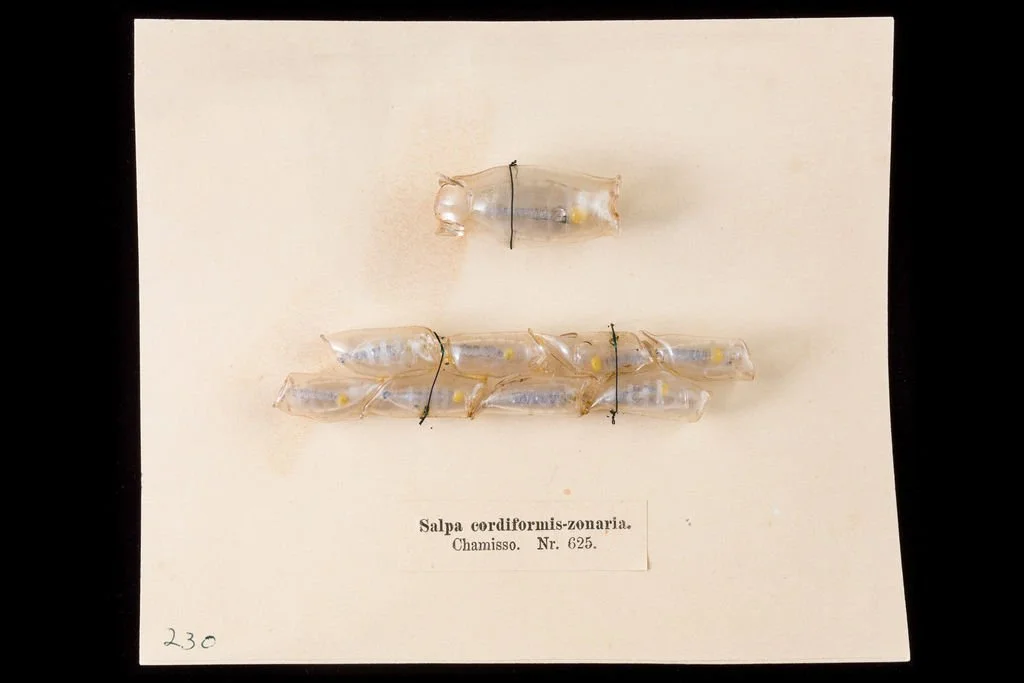
Soestia zonaria, from Cornell Collection of Blaschka Invertebrate Models. Photo: Gary Hodges, used with permission from Cornell University
Salps are another group of soft-bodied non-vertebrate chordates similar to tunicates but which usually float in the open water, where they (with jellyfish and other similarly soft-bodied animals) are referred to as “gelatinous zooplankton”.