
Echinoderms
Echinoderms
Echinoderms (the name means “spiny skin”) are an exclusively marine group that includes sea urchins, sea stars, brittle stars, sea cucumbers, and crinoids (also called “sea lilies”). They have a unique water-vascular system that functions to move tiny appendages called tube feet. They are also distinctive for their five-fold radial symmetry, with many forms having projections usually called “arms”. Many have skeletons (internal or external) made of plates or spicules of calcium carbonate, but some of these skeletal elements are so small that the animals appear soft-bodied when alive. Learn more about echinoderms on the Digital Atlas of Ancient Life.
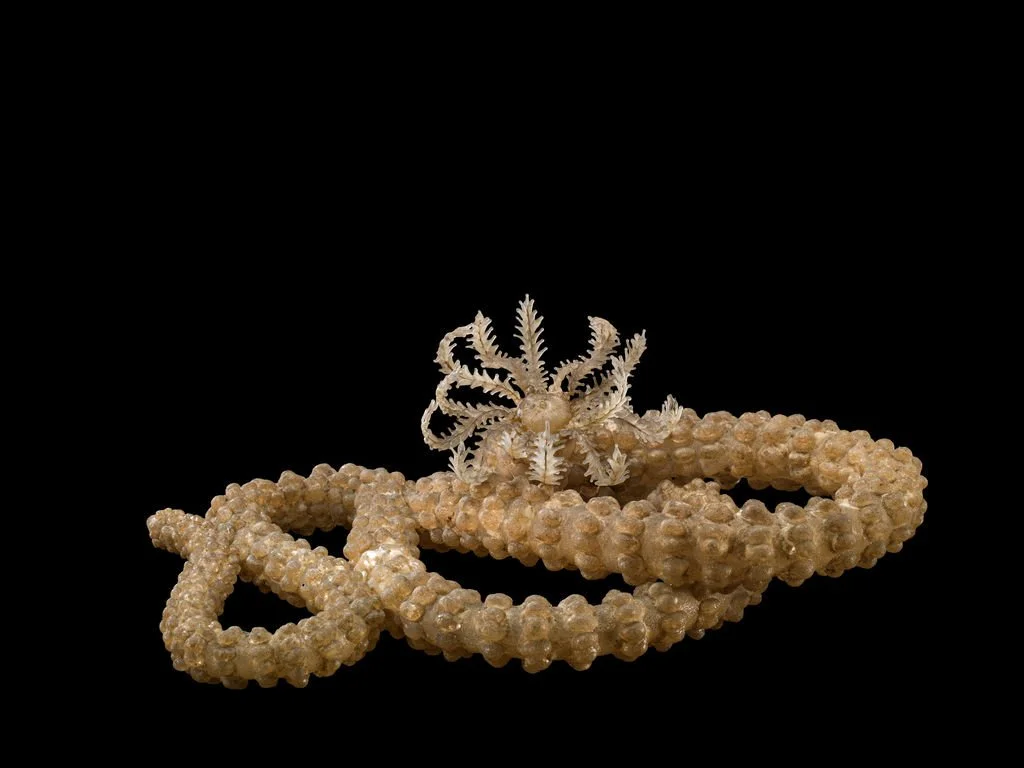
Echinoderm, Synapta maculata. Photo: Corning Museum of Glass, from Cornell Collection of Blaschka Invertebrate Models. Used with permission from Cornell University.
Sea cucumbers (holothurians) are elongate, bag-shaped echinoderms that mostly burrow in soft sediments or live in crevices on the seafloor. Most species are scavengers. The mouth is surrounded by tentacles, which can be pulled back inside the animal. Their skeleton consists of tiny ossicles embedded in leathery skin. More than 1700 living species are known. Learn more about sea cucumbers on the Digital Atlas of Ancient Life.