

Lunar seismometer

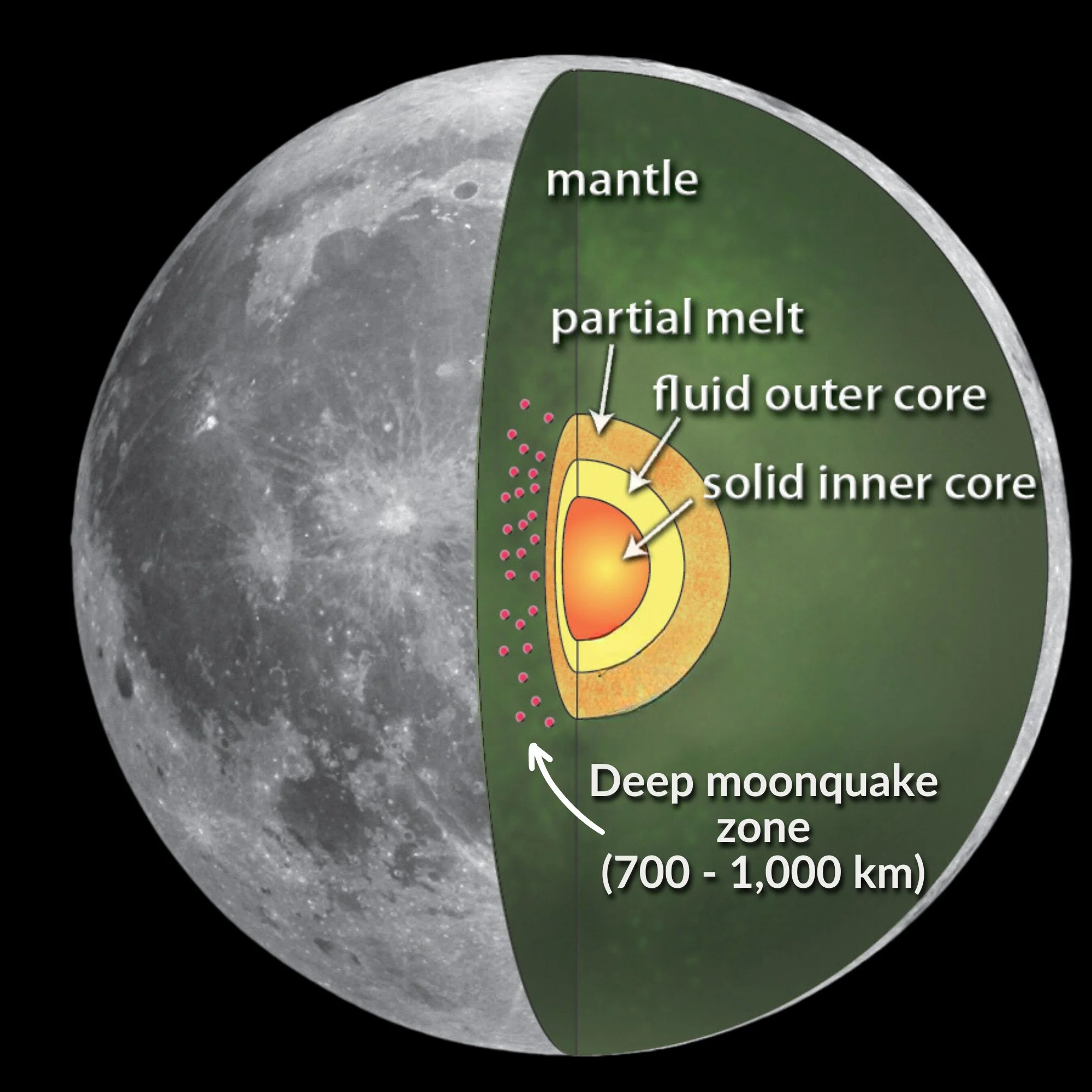
Diagram of interior of the moon. Based on diagram from NASA via Wikimedia Commons.
Did You Know There are Moonquakes?
A moonquake is the lunar equivalent of an Earthquake (i.e., a seismic event on the Moon). The Moon experiences fewer and weaker seismic tremors than the Earth does. This is because the Moon has no tectonic plates that move past each other. This is, in turn, a result of the Moon having cooled faster than the Earth from their original molten states (the Moon cooled faster because it is smaller, and so has a higher ratio of surface area to volume). There is, for example, no process of plate tectonics on the Moon, because the crust is much thicker.
There are at least four kinds of moonquakes:
Deep moonquakes (~700 km below the surface). These are probably caused by gravitational forces acting between the Earth and Moon
Meteorite impact vibrations
Thermal moonquakes. These occur when the frigid lunar crust expands when sunlight returns after the two-week lunar night.
Shallow moonquakes (50-220 kilometers below the surface). The origin of these is still debated by scientists. They may be tectonic, or be caused by other processes, such as landslides or contraction of the moon from cooling.
The first three kinds of moonquakes mentioned above tend to be mild; however, shallow moonquakes can register up to 5.5 on the seismic magnitude scale. Between 1972 and 1977, 28 shallow moonquakes were detected.
The Moon is a layered body comprised of a crust 60 to 100 km (40 to 60 miles) thick, overlying a denser mantle, which makes up most of the Moon’s volume. At the center there probably is a small iron-rich metallic core with a radius of about 350 km (250 miles).
Unlike the Earth, which has abundant heat in its interior that drives volcanism, plate movement, and other tectonic processes at the surface, the Moon is a body in which almost all heat-driven internal processes have run down.
Lunar Seismometer: Prototype of the first instrument to measure “moonquakes”
In May 1961, a program to develop seismic instruments to be deployed on the surface of the Moon was initiated the Lamont Geological Observatory of Columbia University (now the Lamont-Doherty Earth Observatory). During this program, which was sponsored by NASA, prototype seismometers were designed and built to test reaction of the instruments to high launch accelerations and the reduced gravity of the Moon.
Displayed at the Museum of the Earth and shown to the right is one of the first prototype lunar seismometers built as part of this program.
This simple instrument was designed to detect side-to-side movement. A piece of metal swings back and forth, and contacts another piece, which transmits an electrical signal.
This prototype was an early model that did not include electric wiring needed to transmit the detected motion. The actual instrument that landed on the moon was a modification of this design. It reached the Moon with the Apollo 11 lunar module, which landed the first humans on the lunar surface in July, 1969.
The Apollo 11 seismometer returned data for just three weeks, but provided a useful first look at lunar seismology. More advanced seismometers were deployed at the Apollo 12, 14, 15, and 16 landing sites and transmitted data to Earth until September 1977.
Approximately 12,000 moonquakes were recorded during these 8 years. Some of these events were shallow, but most were deep events, located halfway towards the center of the Moon at a depth range of 700-1200 km (435-745 miles).
Learn more
NASA Apollo 11 Seismic Experiment
Latham, G., M. Ewing, F. Press, and G. Sutton, 1969, The Apollo Passive Seismic Experiment. Science, 165 (July 18), pp. 241-250. DOI: 10.1126/science.165.3890.241
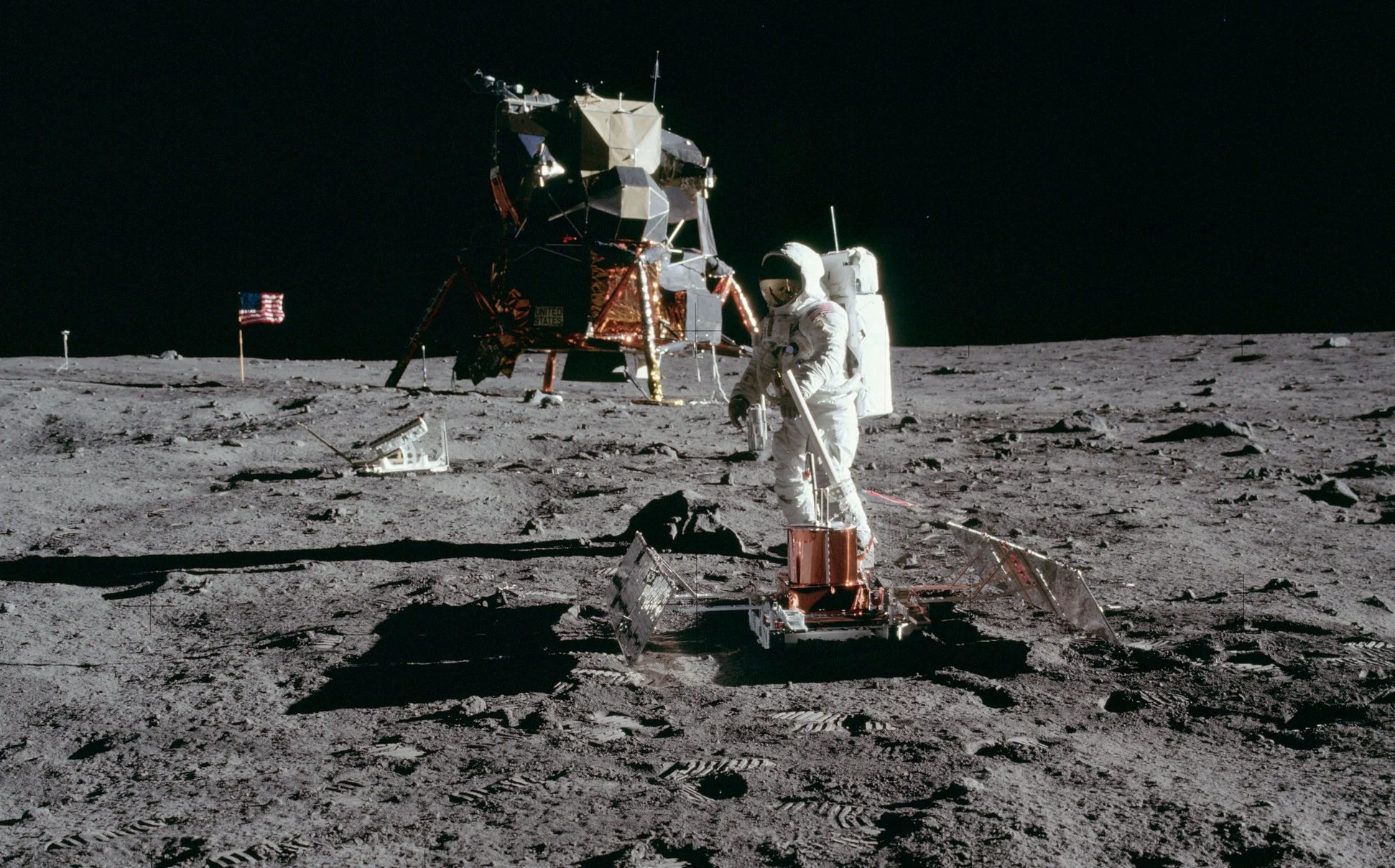
Moon photo from the Apollo 11 mission (1969). In the background is the Lunar Excursion Module (LEM) – the vehicle that landed the astronauts on the Moon. The foreground shows the Passive Seismic Experiment instrument. Photo: NASA/Project Apollo Archive via Flickr(public domain; image cropped).
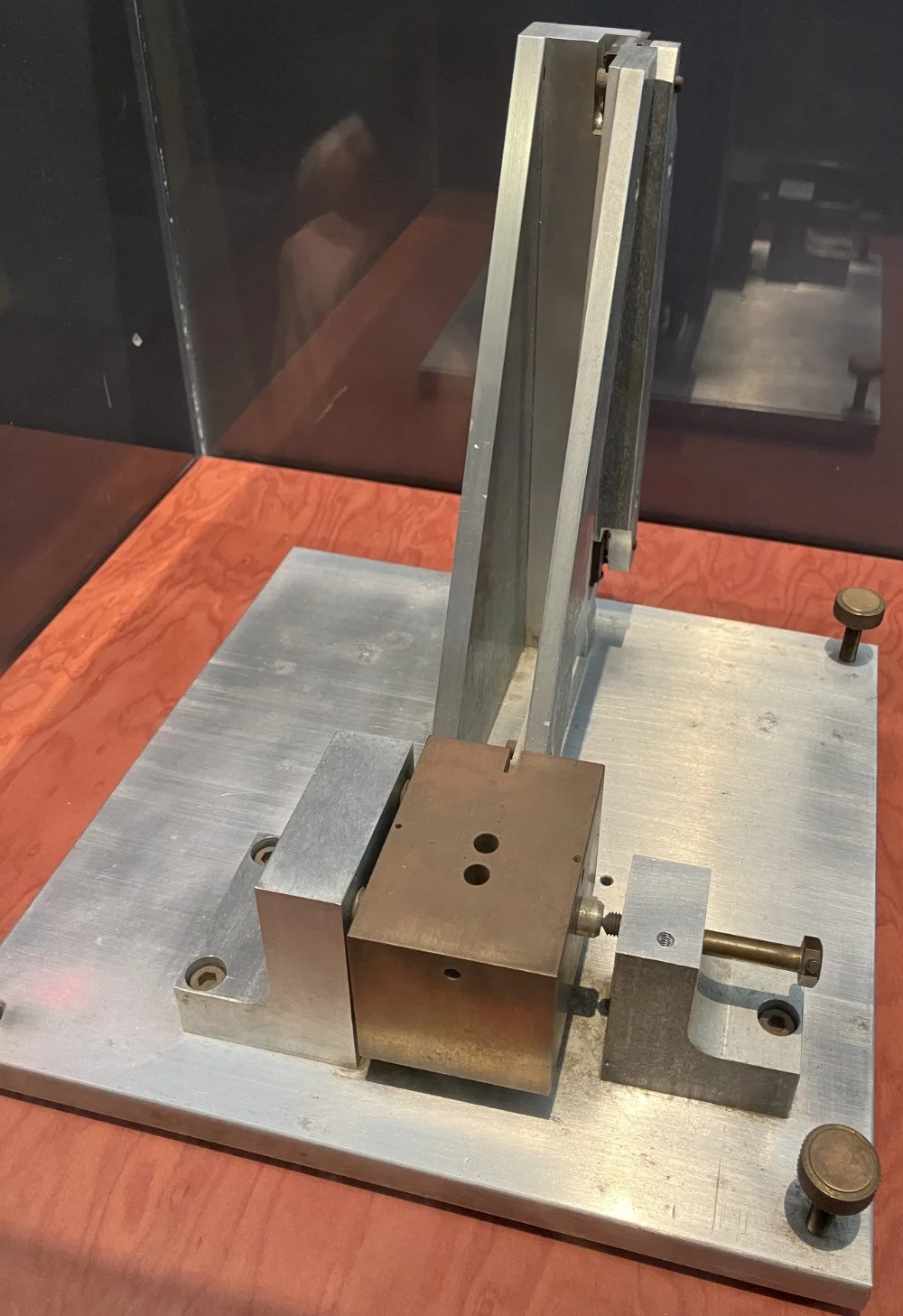
Prototype lunar seismometer on display at the Museum of the Earth. This seismometer measures only horizontal motion in one direction. As a moonquake causes the mass (the brown block in the instrument) to move side-to-side, a voltage that's proportional to the distance the mass moves is generated by circuitry involving a differential capacitor. This voltage is then amplified and recorded as a signal of seismic activity.
Below: Lunar seismogram detecting the landing of the Apollo 12 lunar module on the Moon’s surface.


Muawia Barazangi
The prototype above was designed by Muawia Barazangi (1941-2022) when he was a graduate student at Columbia University in the early 1960s. He went on to become a professor in the Department of Earth and Atmospheric Sciences at Cornell University. He donated it to the Paleontological Research Institution for display in the Museum of the Earth in 2021.
